
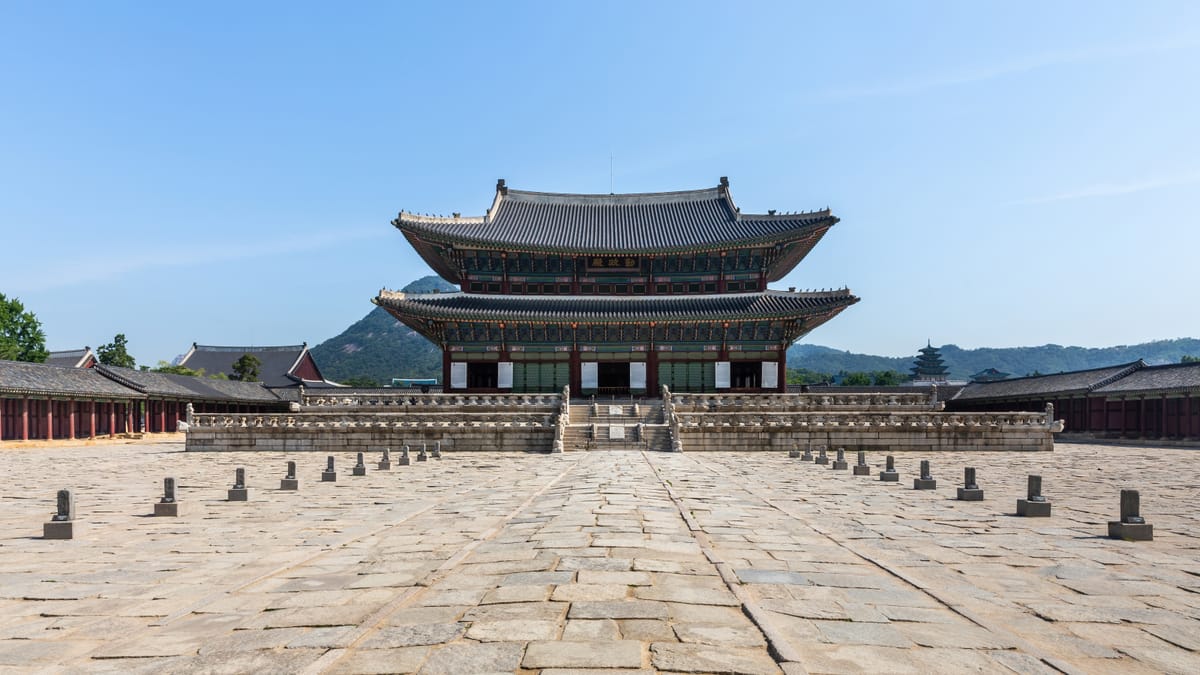
Geunjeongjeon, the throne hall of Gyeongbokgung — photo by Basile Morin, CC BY-SA 4.0, via Wikimedia Commons
A Palace You Can Read Like a Diagram
Most visitors walk into Gyeongbokgung (경복궁, 景福宮) and see a beautiful old palace: sweeping tiled roofs, painted eaves, a stone throne hall at the center. But the people who built it in 1395 were not only building a residence for the king. They were building a cosmogram — a physical model of how the universe was thought to work.
Gyeongbokgung was the main palace of the Joseon dynasty. Its name is drawn from the ancient Chinese classic the Book of Songs (詩經), where Gyeongbok (景福) means something close to "great blessing" or "shining happiness." From the mountains chosen to stand behind it, to the folding screen behind the throne, to the colors painted under the roof, almost every major element encodes the same two ideas that underpin East Asian thought: yin-yang (陰陽) and the five elements (五行, Wood, Fire, Earth, Metal, Water). Once you know the code, you can walk through it and read it.
This article decodes that code — the geomancy of the site, the throne and its famous screen, the painted eaves, and the gate names — so your next visit is a walk through a working model of the cosmos.
The Site: Mountains as Guardians
Before a single hall was raised, the site itself had to be right. Joseon planners chose the location using pungsu (풍수) — Korean geomancy, the same tradition known in China as feng shui. The guiding principle is baesan-imsu (배산임수): "mountain at the back, water at the front." A place worthy of a palace should sit with a protecting mountain behind it and open, flowing space before it.
Gyeongbokgung does exactly this. It is backed to the north by Bugaksan (북악산, 北岳山), with the wider city of Seoul cradled by what were traditionally called the Inner Four Mountains. In geomancy these four positions correspond to the Four Symbols (사신, 四神) — four celestial guardian animals, each tied to a direction:
| Direction | Guardian Mountain | Four Symbols animal |
|---|---|---|
| North | Bugaksan | Black Tortoise (현무, 玄武) |
| East | Naksan | Blue Dragon (청룡, 靑龍) — "Left" |
| West | Inwangsan | White Tiger (백호, 白虎) — "Right" |
| South | Namsan | Red Bird / Vermilion (주작, 朱雀) — "Front" |
Sitting a king inside this ring of guardians was not decoration. It placed the throne at the protected center of a landscape already ordered by the cardinal directions — the same directional logic that governs the five elements. The palace's front-facing, mountain-backed posture announces, in the language of the land itself, that this is the axis of the realm.
The Throne and the Irworobongdo
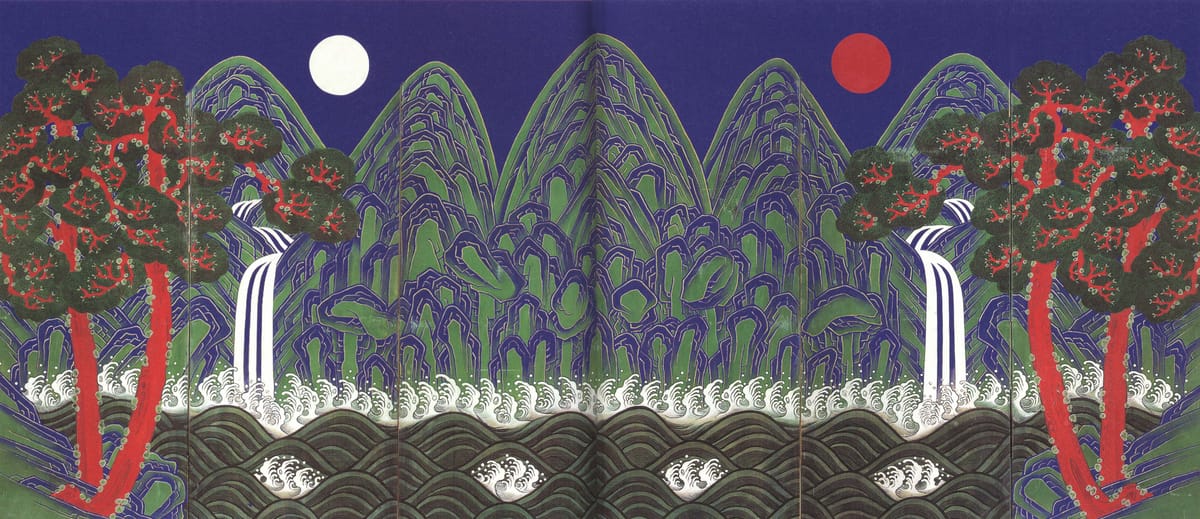
Irworobongdo, the Sun-Moon-Five-Peaks screen (Joseon dynasty) — Public Domain, via Wikimedia Commons
Walk to the heart of the palace and you reach Geunjeongjeon (근정전, 勤政殿), the throne hall. This is the centerpiece of the whole cosmology — and the one thing every visitor should stop and look at closely.
Directly behind the empty throne stands a painted folding screen called the Irworobongdo (일월오봉도) — literally the "Sun, Moon, and Five Peaks" screen. It is one of the most concentrated pieces of symbolism in all of Korean art, and it works on two layers at once.
Sun and Moon: Yin-Yang
At the top of the screen are two discs: a red sun and a white moon. In East Asian cosmology the sun is the purest expression of yang — bright, active, warm — and the moon is the purest expression of yin — dark, receptive, cool. Placed together above the scene, they are yin-yang itself: the two complementary forces whose interplay generates everything else in the world.
Five Peaks: The Five Elements and Directions
Below the sun and moon rise five mountain peaks. Five is not an arbitrary number. It maps to the five elements and the five directions — east, south, center, west, and north — the framework through which the entire physical world was categorized. The five peaks stand for the ordered, structured cosmos: all of space and all of matter, brought into a single balanced arrangement.
The King as the Axis Between Heaven and Earth
Here is the part that makes the screen so powerful. When the king sat on the throne, he sat directly in front of this screen — and his own body completed it. Heaven (sun and moon, yin-yang) hangs above. Earth (the five peaks, the five elements) spreads below. Between them, the screen leaves a space — and that space is filled by the living king.
In this way the ruler becomes the human axis that unites heaven and earth. This reflects a long-standing East Asian idea of the "three powers": Heaven, Earth, and Humanity, with the sovereign as the pivot that binds them. The Irworobongdo is not a landscape painting. It is a statement that the king's presence completes the cosmic order — and that his role is to keep heaven, earth, and humanity in harmony.
Dancheong: The Five Colors Overhead
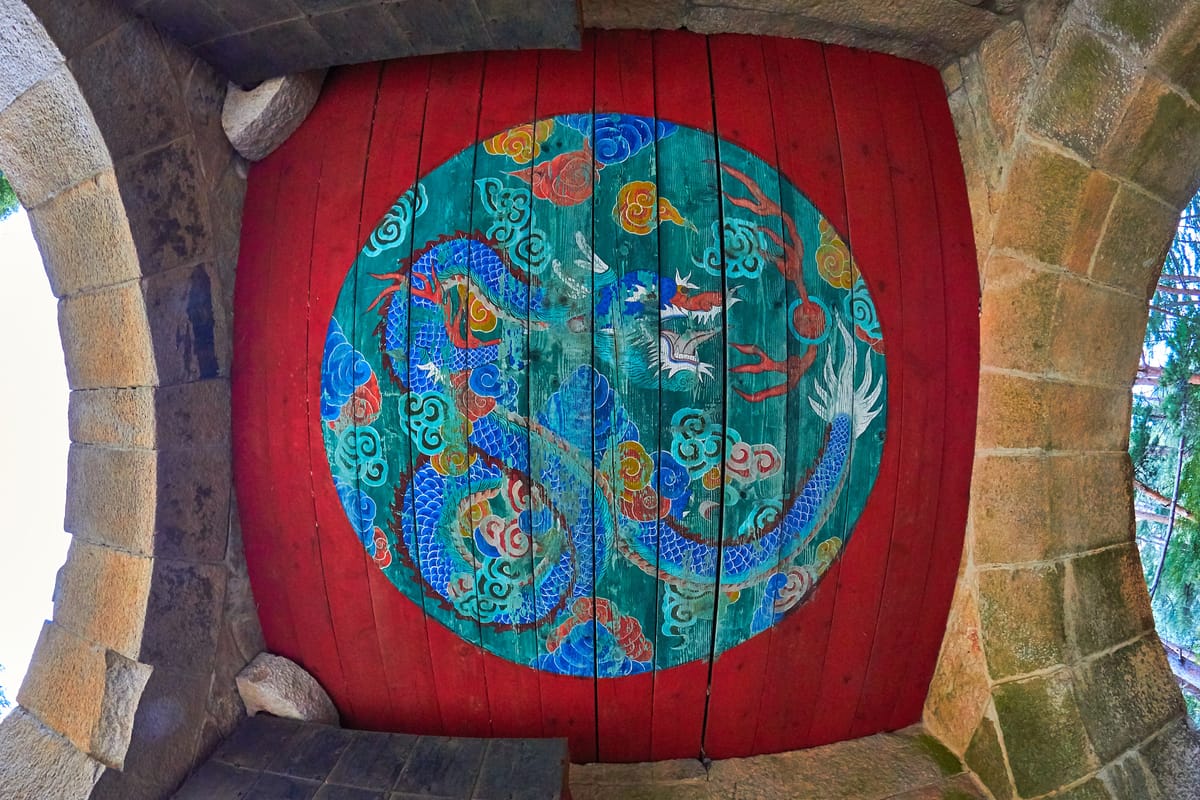
Dancheong, the five-color eave painting — photo by Mathew Schwartz, CC BY 3.0, via Wikimedia Commons
Now look up. The brilliant patterns painted along the eaves and beams are called dancheong (단청). They are beautiful, but they are also systematic. Dancheong is built from the obangsaek (오방색) — the five "orthodox" colors, each bound to one of the five elements and one direction:
| Color | Element | Direction |
|---|---|---|
| Blue-green | Wood | East |
| Red | Fire | South |
| Yellow | Earth | Center |
| White | Metal | West |
| Black | Water | North |
So the color scheme running along the roofline is, in effect, the five elements painted overhead. Beyond protecting the wood and marking a building's status, dancheong wraps the architecture in the same elemental order that governs the site and the throne. The palace is color-coded to the cosmos.
The Gates That Encode the Seasons
The clearest, most satisfying clue is hidden in plain sight — in the names of the gates. The four main gates face the four directions, and the east and west gates literally spell out the seasons that belong to those directions in five-element theory.
- Gwanghwamun (광화문, 光化門) — the grand south main gate, the ceremonial front of the palace.
- Geonchunmun (건춘문, 建春門) — the east gate. Its name means "establishing spring." In five-element thought, spring = Wood = East.
- Yeongchumun (영추문, 迎秋門) — the west gate. Its name means "welcoming autumn." Autumn = Metal = West.
- Sinmumun (신무문, 神武門) — the north gate.
Read the east and west gate names side by side and the design becomes obvious: the palace's east door greets the rising, growing energy of spring and Wood, while its west door greets the cooling, gathering energy of autumn and Metal. The seasons are built into the walls.
What to Look For When You Visit
You don't need to be a scholar to see the cosmology in person. Three simple things to do:
1. Stand in front of Geunjeongjeon and find the screen. Look behind the throne for the Irworobongdo. Spot the red sun and white moon (yin-yang) at the top and the five peaks (five elements) below — then imagine the king seated in the gap, completing the picture.
2. Look up at the dancheong. Pick out the blue-green, red, yellow, white, and black in the painted eaves. You're looking at the five elements overhead.
3. Read the gate names. As you pass the east or west gate, remember Geon-chun ("establish spring," Wood/East) and Yeong-chu ("welcome autumn," Metal/West). The directions are named after the seasons they hold.
You may also notice carved guardian animals and directional zodiac figures along the Woldae (월대) — the raised stone terrace and balustrade in front of the throne hall — another layer of directional symbolism watching over the king.
The Same Cosmos, in Your Own Chart
What makes Gyeongbokgung fascinating is that its organizing principle isn't unique to palaces. Yin-yang and the five elements are the same framework used to read a person. A Korean Saju (four pillars) chart maps your birth moment onto the very same five elements — Wood, Fire, Earth, Metal, Water — and the same yin-yang balance the palace was built to express. Where the palace balances the elements across space, a birth chart balances them across a life.
Curious what your own elemental balance looks like? See yours with the free Saju calculator, and if you want to understand the framework first, start with The Five Elements.
---
This article offers a cultural and historical interpretation of Gyeongbokgung's design. Symbolic readings of heritage architecture can vary between sources and scholars; the aim here is to introduce the widely recognized cosmological ideas woven into the palace, not to make definitive claims about every feature.