
Walk through Dongdaemun or Namdaemun today and you might see them as photogenic old landmarks — stone-and-timber gates marooned in traffic, survivors from another century. But they were never just walls with holes in them. When Joseon built its capital in the 1390s, the gates were laid out as a working diagram of the cosmos. Their names spell out the moral virtues a good society was supposed to embody, and their positions map those virtues onto directions, seasons, and the Five Elements. Seoul, in other words, was planned as a five-element chart you can walk around inside.
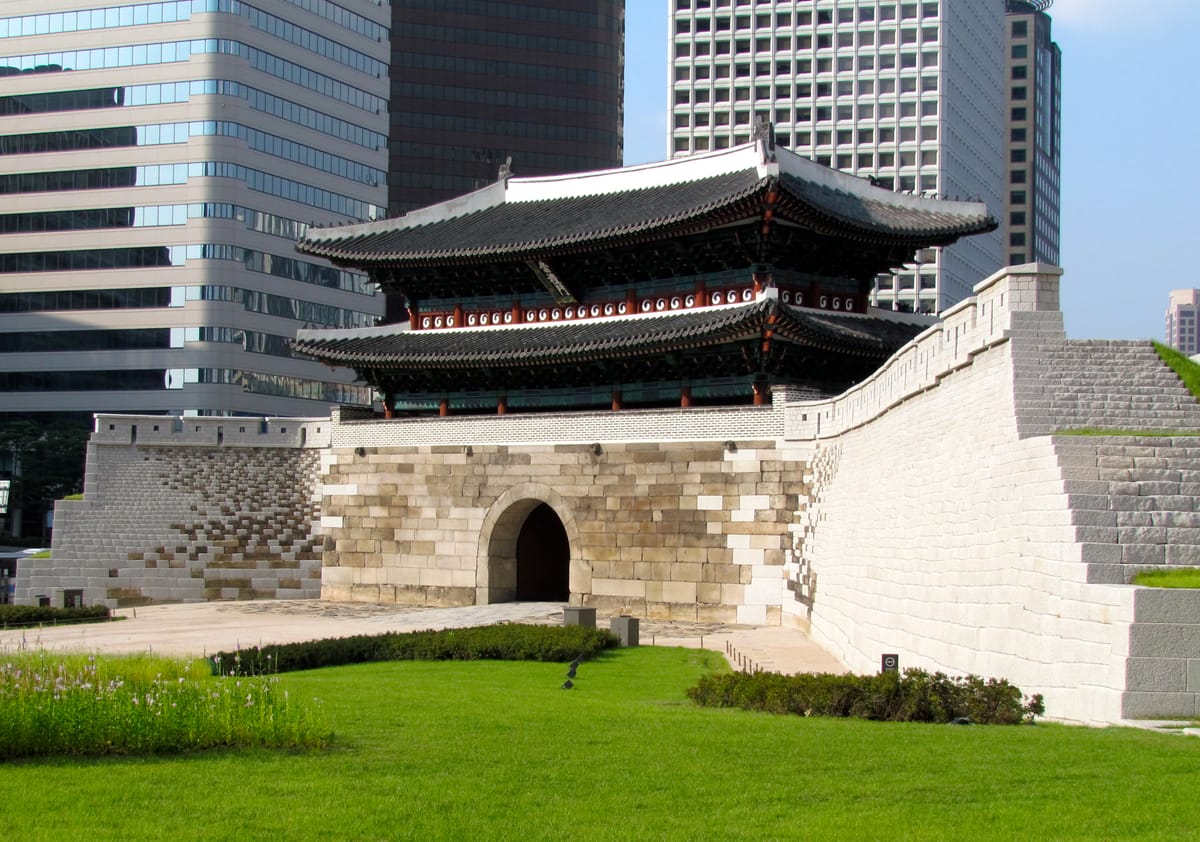
Sungnyemun (Namdaemun), Seoul's south gate — photo by DoulosCore, CC BY-SA 3.0, via Wikimedia Commons
A city planned as cosmology
When the new Joseon dynasty moved its capital to Hanyang (today's Seoul) in the 1390s, the layout was not improvised. The scholar-official Jeong Do-jeon, the dynasty's chief ideologue and planner, designed the city on two overlapping frameworks: Confucian ethics and Korean geomancy (pungsu, 풍수 — the local tradition related to feng shui). The mountains to the north, the river to the south, the palace, the ancestral shrine, the altars, and the great gates were all positioned so that the city itself would model a well-ordered universe.
The clearest surviving expression of this is the naming of the four great gates.
The Five Virtues, Five Elements, and Five Directions
Confucian thought defines Five Constant Virtues (오상, 五常): Benevolence, Righteousness, Propriety, Wisdom, and Faithfulness. Traditional cosmology also recognizes Five Elements (오행, 五行): Wood, Fire, Earth, Metal, and Water — each tied to a direction, a season, and a color. Seoul's planners fused the two systems and hung them on the city's gates.
| Direction | Element | Season | Color | Virtue | Gate |
|---|---|---|---|---|---|
| East | Wood | Spring | Blue-green | Benevolence (In, 仁) | Heunginjimun (Dongdaemun) |
| South | Fire | Summer | Red | Propriety (Ye, 禮) | Sungnyemun (Namdaemun) |
| Center | Earth | — | Yellow | Faithfulness (Sin, 信) | Bosingak (bell pavilion) |
| West | Metal | Autumn | White | Righteousness (Ui, 義) | Donuimun (demolished) |
| North | Water | Winter | Black | Wisdom (Ji, 智) | Sukjeongmun |
Read across any row and you get a complete correspondence. The east gate carries Benevolence, which belongs to Wood, to spring, to the rising sun. The fifth virtue, Faithfulness — Earth, the center — does not sit on the wall at all. It sits in the middle of the city, in the bell pavilion. More on that below.
Gate by gate
East — Heunginjimun (Dongdaemun): Benevolence, Wood
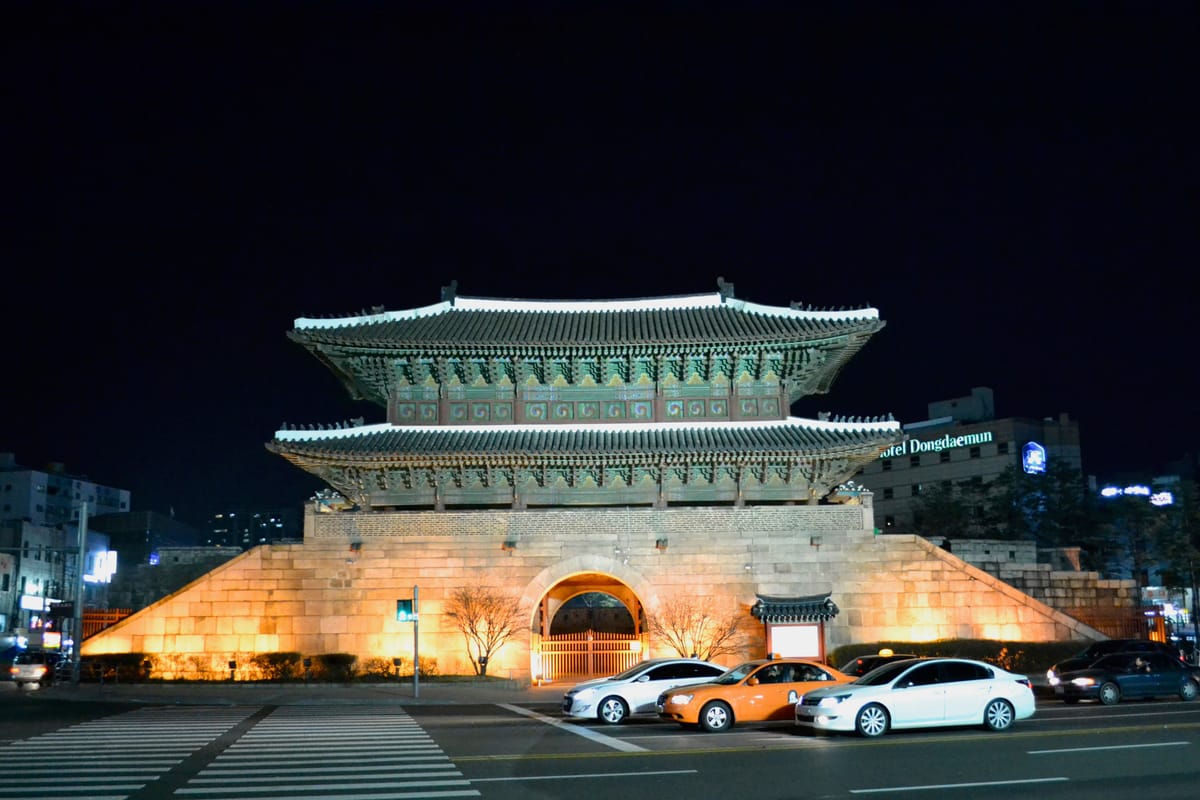
Heunginjimun (Dongdaemun), the east gate — photo by TealAlligator, CC BY-SA 4.0, via Wikimedia Commons
The east gate's formal name is 흥인지문 (興仁之門), Heunginjimun — "Gate of Rising Benevolence." In (仁), Benevolence, is the cardinal Confucian virtue, and it was placed in the east to match Wood, spring, and new growth. Today it's better known by its everyday name, Dongdaemun ("Great East Gate"). The stone-and-timber gate still stands beside a small preserved section of city wall, now ringed by the Dongdaemun fashion district and the Dongdaemun Design Plaza. Note the four-character name — most gate names are three characters; the extra 之 in Heunginjimun is a small distinctive detail traditionally explained by geomantic concerns about the eastern approach.
South — Sungnyemun (Namdaemun): Propriety, Fire
The south gate is 숭례문 (崇禮門), Sungnyemun — "Gate of Revering Propriety." Ye (禮), Propriety or ritual correctness, belongs to Fire, summer, and the south. This is Korea's National Treasure No. 1, and by everyday name it's Namdaemun ("Great South Gate"), which also lends its name to the sprawling market beside it. In February 2008 the wooden upper structure was destroyed by an arson fire — a national trauma — and was painstakingly rebuilt using traditional methods, reopening in 2013. What you see today is that restoration atop the original stone base.
West — Donuimun: Righteousness, Metal
The west gate was 돈의문 (敦義門), Donuimun — "Gate of Promoting Righteousness." Ui (義), Righteousness, belongs to Metal, autumn, and the west. Unlike the others, this gate no longer exists: it was demolished in 1915 during the Japanese colonial period to make way for roads and streetcar lines. Its location, near today's Seodaemun area, is marked and interpreted, but there is no gate to walk through — the western point of the diagram is now a gap.
North — Sukjeongmun: Wisdom, Water (with a caveat)
The north gate is 숙정문 (肅靖門), Sukjeongmun. North corresponds to Water, winter, and the virtue of Wisdom (Ji, 智) — so in the four-virtue scheme, this gate holds the place of Wisdom. Here honesty is required: the gate's actual name uses the character 靖 ("to pacify/settle"), not 智 ("wisdom"). The intended northern correspondence is Wisdom, but the character 智 itself was avoided in the name — a nuance that scholarly accounts note and popular retellings often flatten. The gate sits high on the northern ridge behind the palace, and for much of the Joseon era it was kept largely closed for geomantic reasons.
Center — Bosingak: Faithfulness, Earth
The fifth virtue, Faithfulness (Sin, 信) — the element Earth, whose direction is the center — has no wall gate, because the center of a city is not its edge. Instead it lives in 보신각 (普信閣), Bosingak, the great bell pavilion near today's Jongno. Its name literally carries the character 信 (Faithfulness). Placing the fifth virtue at the city's heart completes the diagram: the four moral qualities guard the boundaries, and the binding virtue that holds everything together sounds from the center.
Why build a city this way?
To Joseon's founders, a capital was a statement about how the world should be ordered — and the ruler's job was to align human society with that natural order. Confucian ethics supplied the content (the virtues), while pungsu geomancy supplied the placement (which direction, which mountain, which flow of energy). Fusing them onto the gates meant that simply naming the city's edges recited a moral and cosmological program.
The centering matters most. In this scheme, Earth and Faithfulness sit at the middle — and so, symbolically, does the sovereign. The four virtues on the walls radiate outward from a trustworthy center. A city that literally ends in Benevolence to the east and Propriety to the south is making an argument: order is not imposed by force at the perimeter, it emanates from integrity at the core.
What to look for when you visit
- Heunginjimun / Dongdaemun (East): Approach on foot and look for the four-character name and the adjacent preserved wall segment. It's an easy pairing with the Dongdaemun market and design plaza.
- Sungnyemun / Namdaemun (South): Stand back to see the rebuilt wooden gatehouse on its old stone base, and remember you're looking at National Treasure No. 1. The market next door is one of Korea's oldest.
- Sukjeongmun (North): This is the trail gate. It sits on the Bugaksan (Bukaksan) fortress-wall walking course behind the palace — the most scenic of the four, reached by a hike rather than a street corner. Check current access rules before you go, as the route has historically had restrictions.
- Bosingak (Center): The bell pavilion near Jongno hosts a public bell-ringing on New Year's Eve, a direct descendant of the old timekeeping bell that once opened and closed the city gates.
- Donuimun (West): There is no gate to see — only its remembered site. Its absence is part of the story.
The same elements are in your own chart
Here's the thread that runs from a 600-year-old wall to something personal: the Five Elements that structure Seoul are the same Five Elements that structure a Korean birth chart. In Saju (사주, the Four Pillars), your birth date and time are read as a particular mix of Wood, Fire, Earth, Metal, and Water — the very system the gates encode. You can see the five elements in your own chart with the free Saju calculator, and if you want the framework itself, The Five Elements explained walks through what each one means.
---
A note on interpretation: the virtue-element-direction scheme described here is a traditional cultural and historical reading of Seoul's gates, drawn from Confucian and geomantic thought. Some correspondences — especially the northern gate and the character choice discussed above — are treated with nuance by historians, and popular versions of the story sometimes smooth over those subtleties. This article is offered as cultural heritage, not as a claim about how any modern city works.