
Korea's traditional year isn't just twelve months. Underneath the calendar runs a second, older rhythm: the 24 solar terms (절기, jeolgi), a set of fixed points in the sun's yearly path that mark when spring truly starts, when the heat breaks, when the frost falls, and when the days turn back toward light. And where the terms go, the holidays and the food follow. Eat red-bean porridge at the winter solstice, rice-cake soup at New Year, half-moon rice cakes at the harvest — each dish sits at a specific turn of the seasonal wheel.
This piece is about that wheel: the seasons the 24 solar terms mark, and the Korean holidays and seasonal customs that grew up around them.
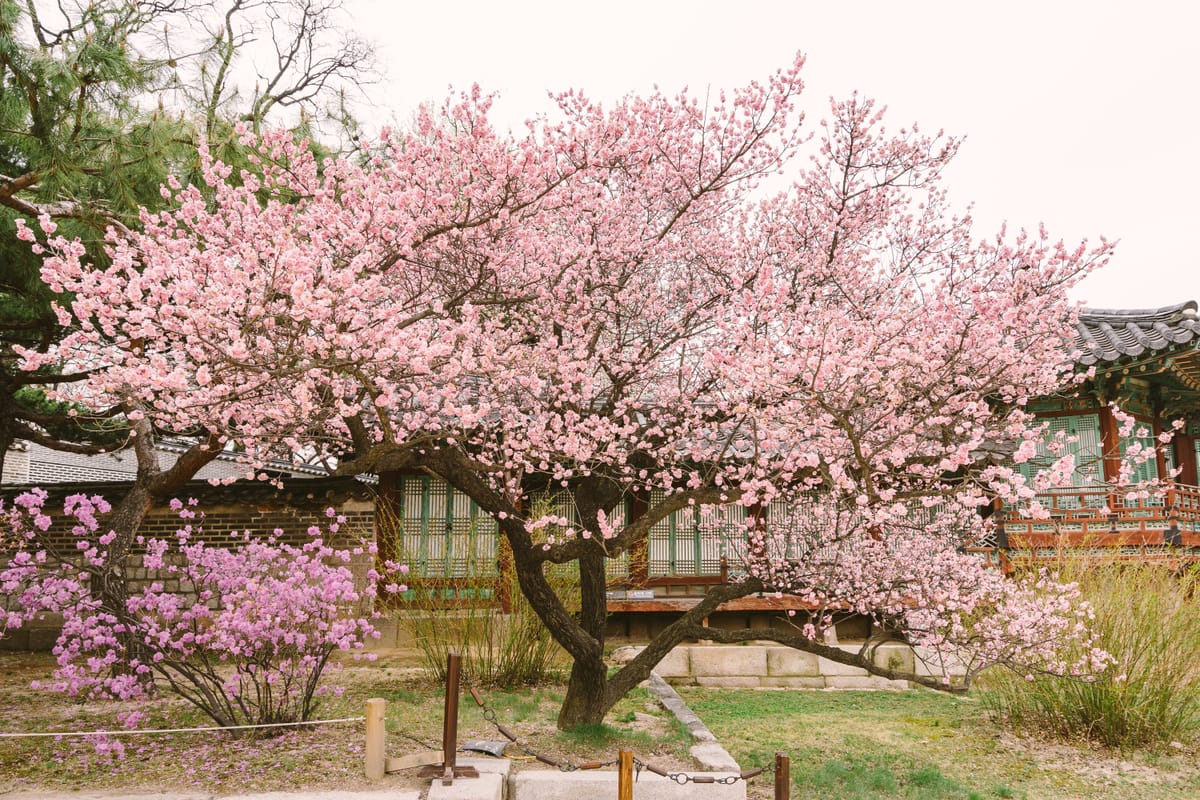
Spring blossoms at Changgyeonggung Palace — photo by Wei-Te Wong, CC BY-SA 2.0, via Wikimedia Commons
What are the 24 solar terms?
The 24 solar terms divide the year into 24 roughly equal segments based on the sun's position along the ecliptic. Because they are tied to the sun, each term falls on nearly the same Gregorian date every year — Ipchun (start of spring) lands around February 4, Haji (summer solstice) around June 21, Dongji (winter solstice) around December 22. They shift by only a day either side.
Here is the distinction that trips people up, so it is worth stating plainly:
- The 24 solar terms are solar. They track the sun and barely move on the Western calendar.
- Korea's big traditional holidays — Seollal, Daeboreum, Dano, Chuseok — are lunar. They follow the moon, so their Gregorian dates drift from year to year.
The two systems interweave. The solar terms set the seasonal backdrop — the weather, the farming cues, the daylight — while the lunar holidays are the human festivals that land against that backdrop. Chuseok is not a solar term; it is a lunar harvest holiday that happens to fall near the autumn ones. Keep that separation in mind and the whole calendar clicks into place.
(This article focuses on the culture. If you want the astronomy and the how-the-clock-works mechanics, see the companion piece on the astronomy of the 24 solar terms.)
The five-element seasonal cycle
In East Asian thought the year is not just four seasons but a cycle of five elements (오행, ohaeng). Each season carries an element, with Earth acting as the transitional, "between-seasons" element — often associated with late summer and the hinge points where one season hands off to the next.
| Season | Element | Character |
|---|---|---|
| Spring | Wood | Sprouting, upward growth, beginnings |
| Summer | Fire | Expansion, heat, peak activity |
| (Between seasons) | Earth | Transition, grounding, ripening |
| Autumn | Metal | Harvest, contraction, clarity |
| Winter | Water | Stillness, storage, return inward |
This is not decoration. The same Wood-Fire-Earth-Metal-Water logic runs through Korean medicine, cooking, color symbolism, and personal destiny reading. Watching the seasons turn is, in this worldview, watching the elements rotate.
Spring — the Wood season
Spring terms: Ipchun (입춘, ~Feb 4, "start of spring") · Usu (우수, ~Feb 19, "rain water") · Gyeongchip (경칩, ~Mar 6, "awakening of insects") · Chunbun (춘분, spring equinox ~Mar 20) · Cheongmyeong (청명, ~Apr 5, "clear and bright") · Gogu (곡우, ~Apr 20, "grain rain").
Spring opens with Ipchun, and Koreans traditionally greet it by writing lucky couplets called ipchunchuk or ipchunbang and pasting them on gates and doorframes. The most famous reads 立春大吉 (ipchun daegil) — "great fortune with the coming of spring." It is a small domestic ritual: welcome the new season, invite good luck into the house.
Late spring brings two closely linked observances. Hansik (한식, "cold-food day," around April 5–6, counted as 105 days after the winter solstice) and the solar term Cheongmyeong fall almost together. On Hansik people traditionally eat cold food — no fresh cooking fire — and, importantly, this is one of the year's key days for tending ancestral graves (seongmyo): clearing the grass, repairing the mound, and honoring the dead as the earth wakes up.
Summer — the Fire season
Summer terms: Ipha (입하, ~May 6, "start of summer") · Soman (소만, ~May 21) · Mangjong (망종, ~Jun 6, "grain in ear") · Haji (하지, summer solstice ~Jun 21) · Soseo (소서, ~Jul 7, "minor heat") · Daeseo (대서, ~Jul 23, "major heat").
Early summer is the season of Dano (단오), a lunar holiday on the 5th day of the 5th lunar month. Its customs are some of the most vivid in the Korean year: *washing the hair in iris (changpo) water for health and shine, swinging on tall standing swings (geune), ssireum (Korean wrestling), and eating surichwi-tteok, a rice cake made with mugwort-family herbs. The Gangneung Danoje, the Dano festival held in the city of Gangneung, is recognized by UNESCO on its list of intangible cultural heritage.
Then comes the fiercest heat, marked not by a solar term but by Sambok (삼복) — the three "dog days": Chobok, Jungbok, and Malbok, which fall in the stretch between Soseo and early autumn. The custom is to eat samgyetang, ginseng chicken soup, served scalding hot. The logic is 이열치열 (iyeol-chiyeol), "fight heat with heat" — a hot, restorative broth to steady the body against the summer's worst.
Autumn — the Metal season
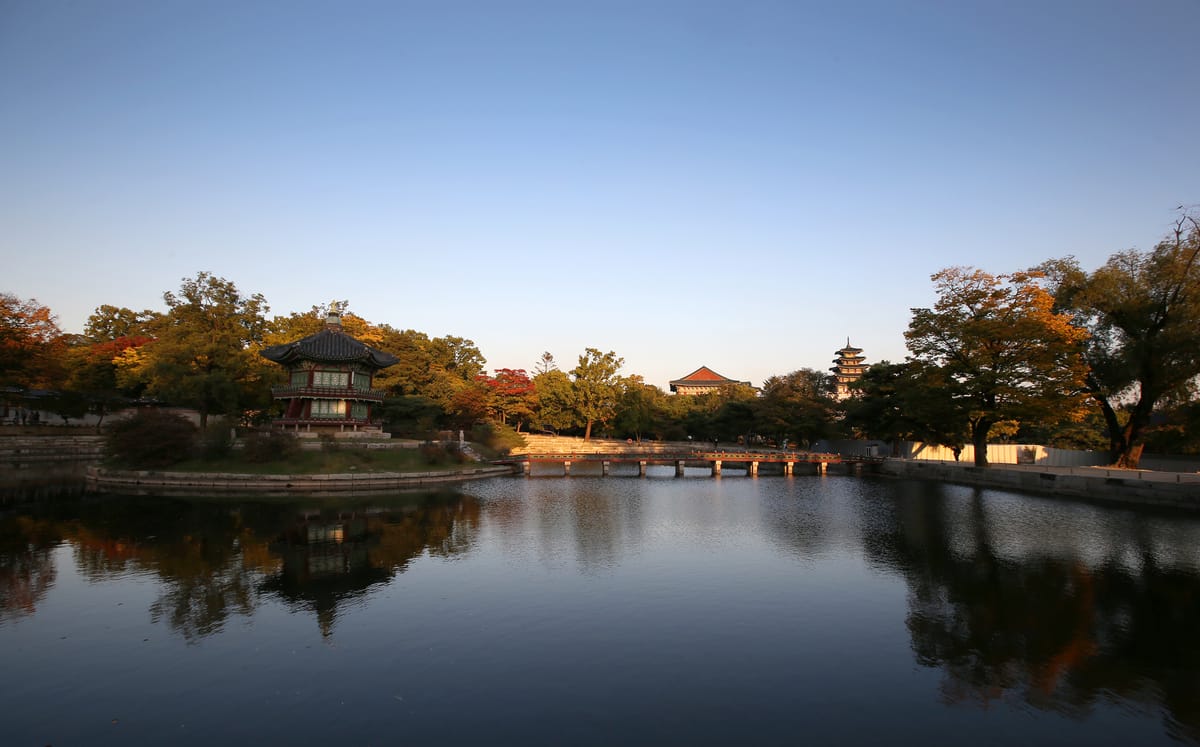
Autumn at Gyeongbokgung (Hyangwonjeong) — photo by Jeon Han / Korea.net, CC BY-SA 2.0, via Wikimedia Commons
Autumn terms: Ipchu (입추, ~Aug 8, "start of autumn") · Cheoseo (처서, ~Aug 23, "end of heat") · Baengno (백로, ~Sep 8, "white dew") · Chubun (추분, autumn equinox ~Sep 23) · Hallo (한로, ~Oct 8, "cold dew") · Sanggang (상강, ~Oct 23, "frost descends").
Autumn holds the harvest, and with it Korea's great thanksgiving holiday, Chuseok (추석), on the 15th day of the 8th lunar month — landing around the Baengno/Chubun window. Chuseok is one of the two biggest holidays of the year. Families gather, travel home, and perform charye, the ancestral rite offering the season's new grain and fruit, and visit graves for seongmyo. The signature food is songpyeon, small half-moon-shaped rice cakes filled with sesame, bean, or chestnut and steamed over pine needles. A full moon overhead, a table of fresh harvest, ancestors remembered — Chuseok is autumn's Metal season made into a meal.
As the terms roll on through Hallo and Sanggang, the dew turns cold and the first frost descends, and the year begins its long tilt toward winter.
Winter — the Water season
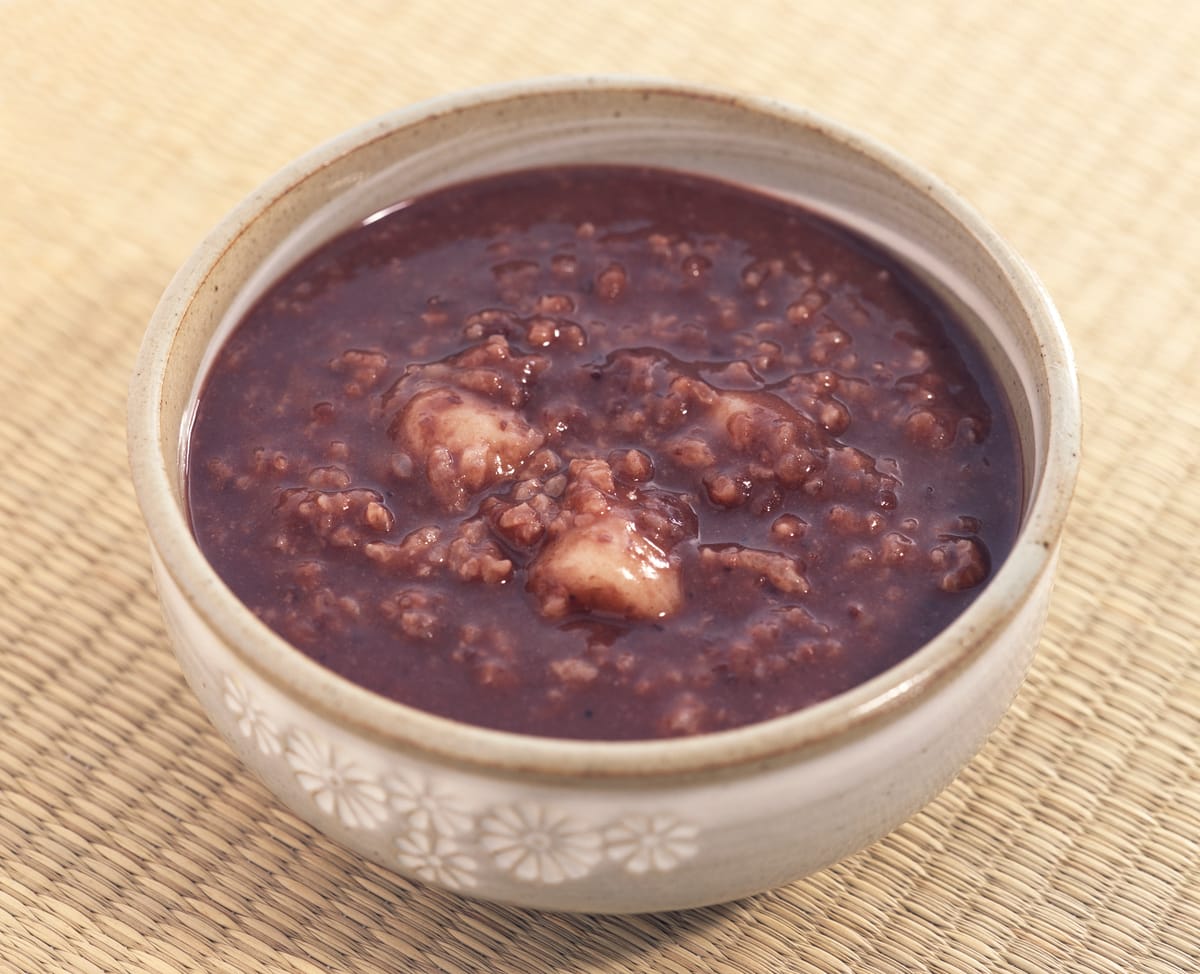
Patjuk, the red-bean porridge eaten on Dongji — CC0, via Wikimedia Commons
Winter terms: Ipdong (입동, ~Nov 7, "start of winter") · Soseol (소설, ~Nov 22, "minor snow") · Daeseol (대설, ~Dec 7, "major snow") · Dongji (동지, winter solstice ~Dec 22) · Sohan (소한, ~Jan 6, "minor cold") · Daehan (대한, ~Jan 20, "major cold").
The heart of winter is Dongji (동지), the winter solstice and the longest night of the year. On Dongji Koreans eat patjuk, red-bean porridge, often studded with little rice-flour balls. The red color was believed to drive off evil spirits in the year's darkest hour. Because the days start lengthening again right after, Dongji was treated almost as a fresh start — it is nicknamed the "little New Year."
Winter closes with the season's coldest terms, Sohan and Daehan, and then — near the very end of the cold, around late January to February — the lunar New Year arrives, and the whole wheel begins again.
The major lunar holidays, against the solar seasons
Four of Korea's most important holidays are lunar, so they float across the Gregorian calendar. Here is how each sits against the solar seasons the terms mark:
Seollal — Lunar New Year
Seollal (설날) is the biggest holiday of the Korean year. It falls near the seam between the coldest winter terms and Ipchun — late January into February. Families perform charye, younger members offer sebae (formal New Year bows to elders), and everyone eats tteokguk, sliced rice-cake soup. Eating a bowl of tteokguk is said to "add a year" to your age — no bowl, no birthday.
Daeboreum — the first full moon
Daeboreum (정월대보름) is the first full moon of the lunar year, on the 15th of the first lunar month — deep winter still, but with the light returning. People eat ogokbap (five-grain rice) and assorted namul (seasoned wild herbs), and crack bureom nuts with their teeth for the year's good health and strong teeth. A cluster of moon-gazing and fire customs rounds out the night.
Dano — early summer
Dano (단오) sits in early summer, near the start of the Fire season, with its iris-water hair-washing, swinging, and wrestling described above.
Chuseok — the harvest moon
Chuseok (추석) lands in autumn near Baengno and Chubun, the harvest thanksgiving with songpyeon and charye described above.
Notice the pattern: the solar terms give you the weather and the farming calendar, fixed year to year; the lunar holidays give you the family gatherings and the feasts, drifting with the moon. Together they make one living year.
A living seasonal rhythm
The 24 solar terms are often described as an old farmer's almanac, and they were. But they are also something warmer than that — a shared sense of when* things should happen. When to paste up a spring couplet, when to eat hot soup against the heat, when to steam songpyeon, when to boil red-bean porridge against the longest night. For many Koreans these turns still carry a quiet cultural weight: a feeling that the year has a proper shape, and that food, family, and the sky are meant to move in step.
You do not have to believe the almanac to feel it. That is the appeal of a seasonal rhythm — it is less a rule than an invitation to notice the year turning.
---
The same 24 solar terms that mark Korea's seasons also set the month boundaries of a Saju chart — in Four Pillars astrology, the month pillar changes on the solar terms, not on the first of the calendar month. If you're curious how your own birth date maps onto this seasonal wheel, see your Four Pillars with the free calculator. And to go deeper on the Wood-Fire-Earth-Metal-Water cycle running underneath it all, read The Five Elements.